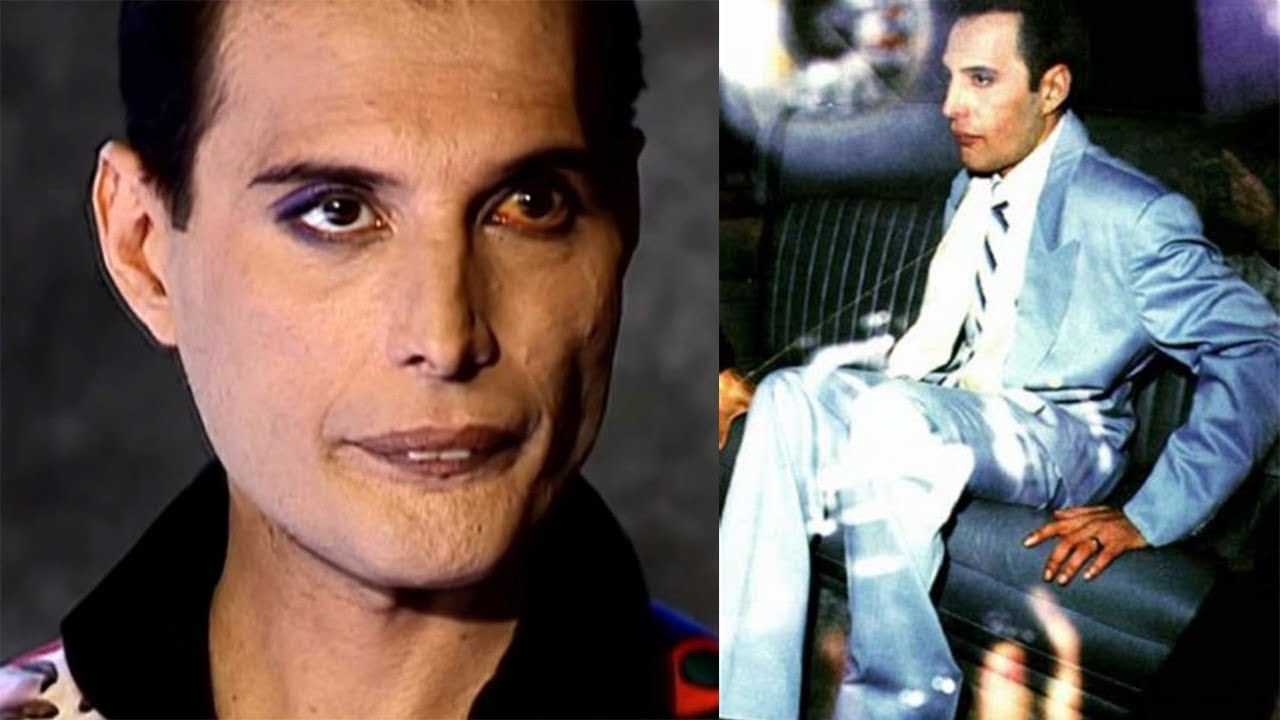
Freddie Mercury Aids Complication is the reason he died in 1991 at age 45 . He confirmed the day before his death that he had contracted the disease, having been diagnosed in 1987. Mercury had continued to record with Queen following his diagnosis, and he was posthumously featured on the band’s final album, Made in Heaven (1995).

Freddie Mercury Last Days:
Freddie Mercury’s close friend and particular adjunct of twelve times, Peter “ Phoebe” Freestone, recalls Freddie Mercury’s last days, his shocking AIDS opinion and Freddie’s determination to die “ on his own terms”.
| Name | Freddie Mercury |
| Profession | British singer, Songwriter, Record Producer, |
| Cause Of Death | Aids |
| Age | 45 |
| Known for | Flamboyant stage persona |
By Freddie Mercury’s side throughout the rollercoaster lift of his career, Peter Freestone lived with the songster in Kensington home, Garden Lodge, and was with him throughout his battle with AIDS and the last days of the songster’s life.
Peter, who’s a close friend of the remaining band members of Queen and was an functionary on- set counsel for the Oscar- winning film Bohemian Rhapsody speaks candidly of his gests living and working with Freddie through his devoted channel “ Ask Phoebe” on the sanctioned Freddie Mercury website.
Peter, who’s known to Freddie’s suckers as “ Phoebe” the surname the songster gave him met the Queen frontal man while he was working in the wardrobe department at the Royal Ballet in 1979.
About Freddie Mercury:
Freddie Mercury (born Farrokh Bulsara; 5 September 1946 – 24 November 1991) was a British songster, tunesmith, record patron, and lead voice of the gemstone band Queen. Regarded as one of the topmost vocalizers in the history of gemstone music.
He was known for his flamboyant stage persona and four-octave range. Mercury defied the conventions of a gemstone frontal man, with his largely theatrical style impacting the cultural direction of Queen.
Born in 1946 in Zanzibar to Paris-Indian parents, he attended English- style boarding seminaries in India from the age of eight and returned to Zanzibar after secondary academy. In 1964, his family fled the Zanzibar Revolution, moving to Middlesex, England.
Having studied and written music for times, he formed Queen in 1970 with guitarist Brian May and drummer Roger Taylor. Mercury wrote multitudinous successes for Queen, including “ Killer Queen”, “ Bohemian Rapture”, “ Notoriety to Love”, “ We Are the Titleholders”, “ Do n’t Stop Me Now”, and “ Crazy Little Thing Called Love”.
His attractive stage performances frequently saw him interact with the followership, as displayed at the 1985 Live Aid musicale. He also led a solo career and served as a patron and guest musician for other artists. Mercury failed in 1991 at age 45 due to complications from AIDS.
He verified the day before his death that he’d contracted the complaint, having been diagnosed in 1987. Mercury had continued to record with Queen following his opinion, and he was posthumously featured on the band’s final reader, Made in Heaven (1995).
In 1992, his homage musicale was held at Webley Stadium. As a member of Queen, Mercury was posthumously instated into the Rock and Roll Hall of Fame in 2001, the Songwriters Hall of Fame in 2003, and the UK Music Hall of Fame in 2004.
In 1990, he and the other Queen members were awarded the Brit Award for Outstanding Contribution to British Music, and one time after his death Mercury was awarded it collectively.
In 2005, Queen were awarded an Ivor Novella Award for Outstanding Song Collection from the British Academy of Songsmiths, Melodists, and Authors. In 2002, Mercury ranked number 58 in the BBC’s bean of the 100 Greatest Britons. His career with Queen was dramatized in the 2018 biopic Bohemian Rhapsody.
Summary
Freddie Mercury is the american Songwriter and band singer. He is famous for his musicales. Mercury spent utmost of his nonage in India where he began taking piano assignments at the age of seven while living with cousins.
Early life
The house in Zanzibar where Mercury lived in his early times. Mercury was born Farrokh Bulsara in Stone Town in the British mandate of Zanzibar ( now part of Tanzania) on 5 September 1946. His parents, Bomu (1908 – 2003) and Jeer Bulsara (1922 – 2016), were from the Paris community of western India.
The Bulsaras had origins in the megacity of Bulbar ( now Val sad) in Gujarat. He’d a youngish family, Kashmiri. The family had moved to Zanzibar so that Bomu could continue his job as a cashier at the British Colonial Office.
As Parses, the Bulsaras rehearsed Zoroastrianism. Mercury was born with four supererogatory incisors, to which he attributed his enhanced singing range. As Zanzibar was a British mandate until 1963.
Mercury was born a British subject, and on 2 June 1969 was registered a citizen of the United Kingdom and colonies after the family had emigrated to England. Mercury spent utmost of his nonage in India where he began taking piano assignments at the age of seven while living with cousins.
In 1954, at the age of eight, Mercury was transferred to study atSt. Peter’s School, a British- style boarding academy for boys, in Panchami near Bombay. At the age of 12, he formed a academy band, the Excited, and covered gemstone and roll artists similar as Cliff Richard and Little Richard.
One of Mercury’s former bandmates from the Excited has said “ the only music he heeded to, and played, was Western pop music”. A friend recalls that he’d “ an uncanny capability to hear to the radio and renewal what he heard on piano”.
It was also at St. Peter’s where he began to call himself “ Freddie”. In February 1963 he moved back to Zanzibar where he joined his parents at their flat. In the spring of 1964, Mercury and his family fled to England from Zanzibar to escape the violence of the revolution against the Sultan of Zanzibar.
And his substantially Arab government, in which thousands of ethnical Arabs and Indians were killed. They moved to 19 Hamilton Close, Felltham, Middlesex, a city 13 country miles (21 km) west of central London.
The Bulsaras briefly dislocated to 122 Hamilton Road, before settling into a small house at 22 Gladstone Avenue in late October. After first studying art at Isle worth Polytechnic in West London, Mercury studied graphic art and design at Eagling Art College, graduating with a parchment in 1969.
He latterly used these chops to design heraldic arms for his band Queen. Following scale, Mercury joined a series of bands and vended alternate- hand Edwardian clothes and scarves in Kensington Market in London with Roger Taylor.
Taylor recalls, “ Back also, I did n’t really know him as a songster he was just my mate. My crazy mate! If there was fun to be had, Freddie and I were generally involved. “ He also held a job as a baggage tutor at Heathrow Airport.
Other musketeers from the time remember him as a quiet and shy youthful man with a great interest in music. In 1969, he joined Liverpool- grounded band Ibex, latterly renamed Wreckage, which played “ veritably Hendrix- style, heavy blues”.
He compactly lived in a flat above the Dove hollow Towers, a cantina close to Penny Lane in Liverpool’s Mosley Hill quarter. When this band failed to take off, he joined an Oxford- grounded band, Sour Milk Ocean, but by early 1970 this group had broken up as well.
In April 1970, Mercury teamed up with guitarist Brian May and drummer Roger Taylor, to come supereminent songster of their band Smile. They were joined by bassist John Deacon in 1971. Despite the reservations of the other members and Trident Studios, the band’s original operation, Mercury chose the name “ Queen” for the new band.
He latterly said, “ It’s veritably regal obviously, and it sounds splendid. It’s a strong name, veritably universal and immediate. I was clearly apprehensive of the connotations, but that was just one hand of it.”
At about the same time, he fairly changed his surname, Bulsara, to Mercury. Shortly before the release of Queen’s tone- named first reader, Mercury designed the band’s totem, known as the “ Queen crest”.
The totem combines the wheel signs of the four band members two Napoleons for Cleric and Taylor ( subscribe Leo), a grouser for May (Cancer), and two brownies for Mercury (Virgo). The Napoleons embrace a stylized letter Q, the grouser rests atop the letter with dears rising directly above it, and the brownies are each sheltering below a captain.
A crown is shown inside the Q, and the whole totem isover-shadowed by an enormous phoenix. The Queen crest bears a passing resemblance to the Royal fleece of arms of the United Kingdom, particularly with the captain sympathizers.
Although Mercury’s speaking voice naturally fell in the baritone range, he delivered most songs in the tenor range. His known range extended from bass low F (F2) to soprano high F (F6). He could belt up to tenor high F (F5).
Chronicler David Bret described his voice as “ raising within a many bars from a deep, throaty gemstone- scowl to tender, vibrant tenor, also on to a high-pitched, perfect coloratura, pure and crystalline in the upper rung”.
Spanish soprano Montserrat Caballed, with whom Mercury recorded an reader, expressed her opinion that “ the difference between Freddie and nearly all the other gemstone stars was that he was dealing the voice”.
His fashion was astonishing. No problem of tempo, he sang with an incisive sense of meter, his placement was veritably good and he was suitable to glide painlessly from a register to another. He also had a great musicality.
His phrasing was subtle, delicate and sweet or energetic and slamming. He was suitable to find the right coloring or suggestive nuance for each word. The Who lead songster Roger Daley described Mercury as “ the stylish virtuoso gemstone‘n’roll songster of all time.
He could sing anything in any style. He could change his style from line to line and, God, that’s an art. And he was brilliant at it.” Agitating what type of person he wanted to play the supereminent part in his musical Jesus Christ Superstar, Andrew Lloyd Webber said “.
Summary
He has to be of enormous seductiveness, but he also has to be a genuine, genuine gemstone tenor. That’s what it is. Really suppose Freddie Mercury, I mean that’s the kind of range we ’re talking about.”
Exploration of Freddie Mercury Songs
A exploration platoon shouldered a study in 2016 to understand the appeal behind Mercury’s voice. Led by Professor Christian Sauces, the platoon linked his specially briskly vibrato and use of subharmonics as unique characteristics of Mercury’s voice, particularly in comparison to pieces vocalizers.
The exploration platoon studied ditty samples from 23 commercially available Queen recordings, his solo work, and a series of interviews of the late artist. They also used an endoscopic videotape camera to study a gemstone songster brought in to imitate Mercury’s singing voice. Mercury wrote 10 of the 17 songs on Queen’s Greatest Hits reader
-
Bohemian Rapture
-
Seven Swell of Rhyme
-
Killer Queen
-
Notoriety to Love
-
Good Old-Fashioned Nut Boy
-
We Are the Titleholders
-
Bike Race
-
Do n’t Stop Me Now
-
Crazy Little Thing Called Love
-
Play the Game
In 2003 Mercury was posthumously instated into the Songwriters Hall of Fame with the rest of Queen, and in 2005 all four band members were awarded an Ivor Novella Award for Outstanding Song Collection from the British Academy of Songsmiths, Melodists, and Authors.
The most notable aspect of his songwriting involved the wide range of stripes that he used, which included, among other styles, rockabilly, progressive gemstone, heavy essence, philosophy, and disco. As he explained in a 1986 interview, “ I detest doing the same thing again and again and again.
I like to see what’s passing now in music, film and theatre and incorporate all of those effects.” Compared to numerous popular songsmiths, Mercury also tended to write musically complex material. For illustration, “ Bohemian Rapture” isnon-cyclical in structure and comprises dozens of passions.
He also wrote six songs from Queen II which deal with multiple crucial changes and complex material. “ Crazy Little Thing Called Love”, on the other hand, contains only a many passions. Although Mercury frequently wrote veritably intricate chimes, he claimed that he could slightly read musical
. Mercury was noted for his live performances, which were frequently delivered to colosseum cult around the world. He displayed a largely theatrical style that frequently elicited a great deal of participation from the crowd.
A pen for The Spectator described him as “ a pantomime out to tease, shock and eventually charm his followership with colorful extravagant performances of himself.” David Bowie, who performed at the Freddie Mercury Tribute Concert and recorded the song “ Under Pressure” with Queen.
Praised Mercury’s performance style, saying “ Of all the more theatrical gemstone players, Freddie took it further than the rest he took it over the edge. And of course, I always respected a man who wears tights.
I only saw him in musicale formerly and as they say, he was surely a man who could hold an followership in the win of his hand.” Queen guitarist Brian May wrote that Mercury could make “ the last person at the reverse of the farthest stage in a colosseum feel that he was connected”.
Mercury’s main mount on stage was a broken microphone stage; after accidentally snapping it off the heavy base during an early performance, he realized it could be used in endless ways.
One of Mercury’s most notable performances with Queen took place at Live Aid in 1985. Queen’s performance at the event has ago been suggested by a group of music directors as the topmost live performance in the history of gemstone music.
The results were vented on a TV program called “ The World’s Greatest Gigs”. Mercury’s important, sustained note during the a cappella section came to be known as “ The Note Heard Round the World”.
In reviewing Live Aid in 2005, one critic wrote, “ Those who collect lists of Great Rock Front men and award the top spots to Jagger, Robert Plant,etc. all are shamefaced of a terrible oversight. Freddie, as substantiated by his Dionysian Live Aid performance, was fluently the most holy of them all.
Summary
”Queen roadie Peter Hence states, “ It was n’t just about his voice but the way he commanded the stage. For him it was each about interacting with the followership and knowing how to get them on his side. And he gave everything in every show.”
Total Musicales Attend
Throughout his career, Mercury performed an estimated 700 musicales in countries around the world with Queen. A notable aspect of Queen musicales was the large scale involved. He formerly explained, “ We ’re the CecilB. DeMille of gemstone and roll, always wanting to do effects bigger and better.”
The band was the first ever to play in South American colosseums, breaking worldwide records for musicale attendance in the Murrumba Stadium in São Paulo in 1981. In 1986, Queen also played behind the Iron Curtain when they performed to a crowd of in Budapest, in what was one of the biggest gemstone musicales ever held in Eastern Europe.
Mercury’s final live performance with Queen took place on 9 August 1986 at Kenworth Park in England and drew an attendance estimated as high as. A week previous to Kenworth, May recalled Mercury saying “ I ’m not going to be doing this ever.
Summary:
This is presumably the last time.” With the British public hymn “ God Save the Queen” playing at the end of the musicale, Mercury’s final act on stage saw him draped in a mask, holding a golden crown above, bidding farewell to the crowd.
Frequently asked questions
Here are some frequently asked questions related to the article Freddie mercury aids:
1. Who lives in Freddie Mercury’s house now?
Mary Austin and her family still live in Garden Lodge, where the décor is supposedly important the same as Freddie Mercury left it. Outdoors on the road, though it has been further than two decades since Mercury’s death, Queen suckers still leave letters, flowers, gifts, and graffiti to remember the songster.
2. What happened to Freddie Mercury’s girlfriend Mary?
These days, Mary, 70, lives a quiet life in the London manse Freddie left to her where Queen suckers still make regular visits to pay their felicitations. She has been married doubly but is now disassociated. She shares two grown-up sons, Jamie and Richard, with one of her spouses, Piers Cameron.
3. Who was Mary Freddie Mercury’s girlfriend?
Girlfriend of freddie was Mary Austin, Freddie Mercury and Mary Austin maintained a seven- time-long romantic relationship and remained close until Mercury’s early death. Mary Austin was noway fairly Freddie Mercury’s woman but she was the only true love in the short and turbulent life of the notorious Queen frontal man.
4. Who lives in Freddie Mercury’s house now?
Mary Austin and her family still live in Garden Lodge, where the décor is supposedly important the same as Freddie Mercury left it. Outdoors on the road, though it has been further than two decades since Mercury’s death, Queen suckers still leave letters, flowers, gifts, and graffiti to remember the songster.
Conclusion
In life and in death, Freddie Mercury frequently remained an intriguingly inscrutable riddle. The musical biopic Bohemian Rhapsody, an Oscar frontrunner that’s made an astonishing near$ 1 billion at the worldwide box office, shines a light on some aspects of the Queen frontal man’s day-to- day actuality, while still maintaining his gauzy, larger-than- life air.